You have probably noticed it: you open a familiar app and it looks different. Yet there was no update in the store. New blocks appeared, the page structure changed, an offer popped up.
That is the result of Backend-Driven UI (BDUI) — an approach where the app receives its interface from the server. BDUI lets you control the app interface through an LMP (Layout Management Platform). You decide which blocks appear on the screen, in what order, under which conditions and for which users.
Which means you can:
- update the structure of the home or category screen without a release;
- run an experiment with a new block order or alternative layouts;
- switch off or swap an element quickly if it gets in the way;
- keep platforms consistent without manual synchronisation.
You manage app behaviour as flexibly as you manage a website or a CMS.
📌 BDUI (Backend-Driven UI)
An approach where the app interface is controlled from the server. Instead of hard-coding block order, copy and scenarios, you describe them in a configuration and the app renders the right UI in real time. That lets you ship changes without the front-end team and without releases.
📌 LMP (Layout Management Platform)
A tool for managing screens inside the app. Through the LMP you define what the user sees, how elements are arranged, under which conditions they show up and which data they depend on. It works like a CMS, but for mobile UI.
👉 They work together: BDUI makes the app flexible, and the LMP gives you the tool to control that flexibility.
Why BDUI matters in e-commerce right now
The mobile app has become the primary channel for customer interaction. Promotions run there, new categories appear there, offers for repeat buyers launch there. All of it has to reach the interface — and preferably fast.
Reality looks different. To make even a simple change you have to ship a new app version, pass store review and wait for users to install it. That often takes weeks. And even when everything goes perfectly, up to 30–40% of your audience can stay on the old version for several weeks more.
BDUI solves that: you change page structure and content centrally, through the LMP. Users see the update the moment you publish it — regardless of the app version they run. That gives you the flexibility and the speed the business asks for.
Gravity Field SDK — a ready-made BDUI solution
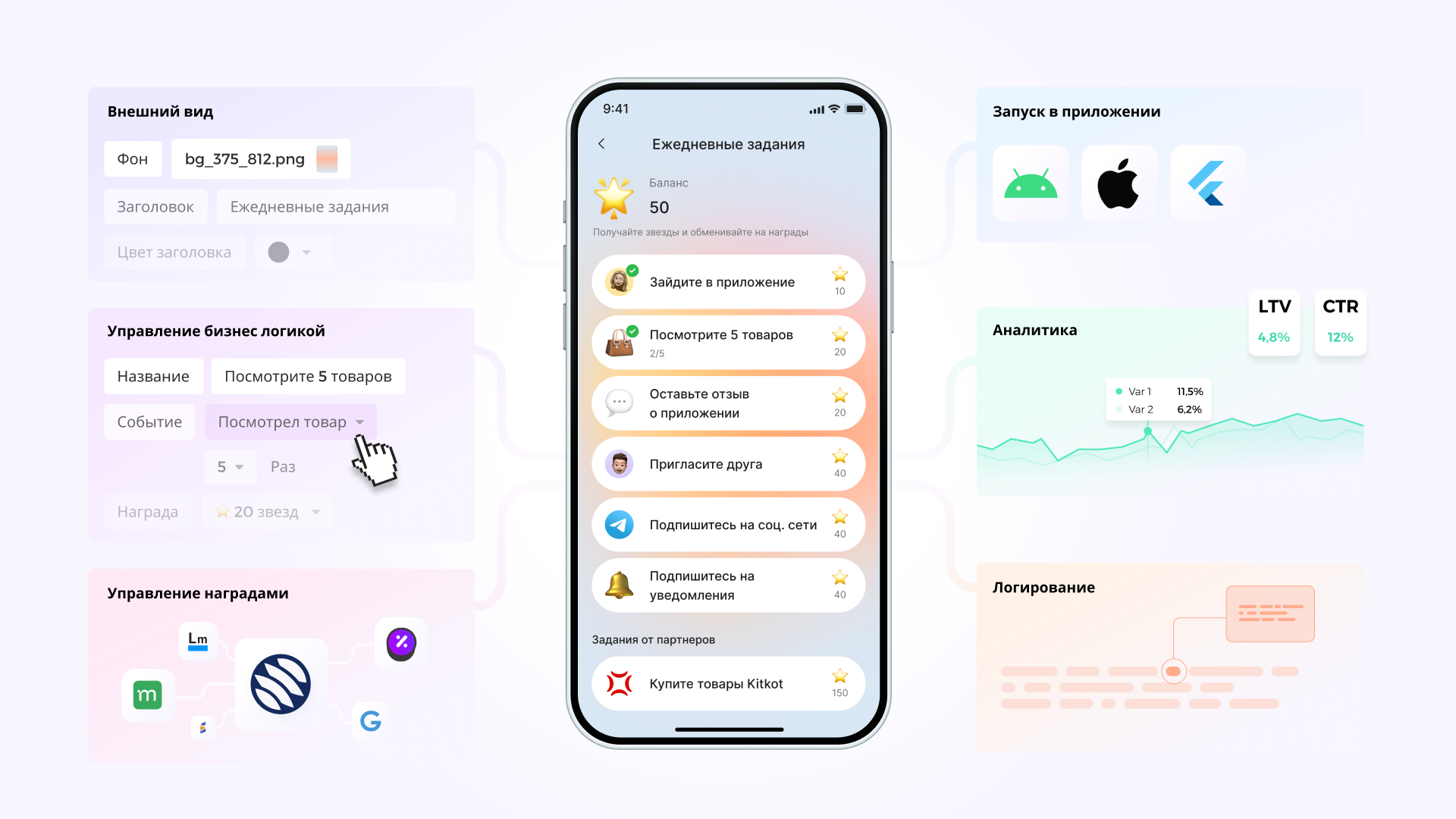
The mobile marketing platform is a ready-made tool for product and marketing teams that need to manage the in-app experience without shipping a new app version.
Out-of-the-box formats
The Gravity Field SDK ships with two format families that work out of the box:
- in-app — elements that appear on top of the interface (modal, snackbar, bottom sheet, full-screen overlay);
- inline — embedded blocks that appear inside the page body and fit naturally into the app structure.
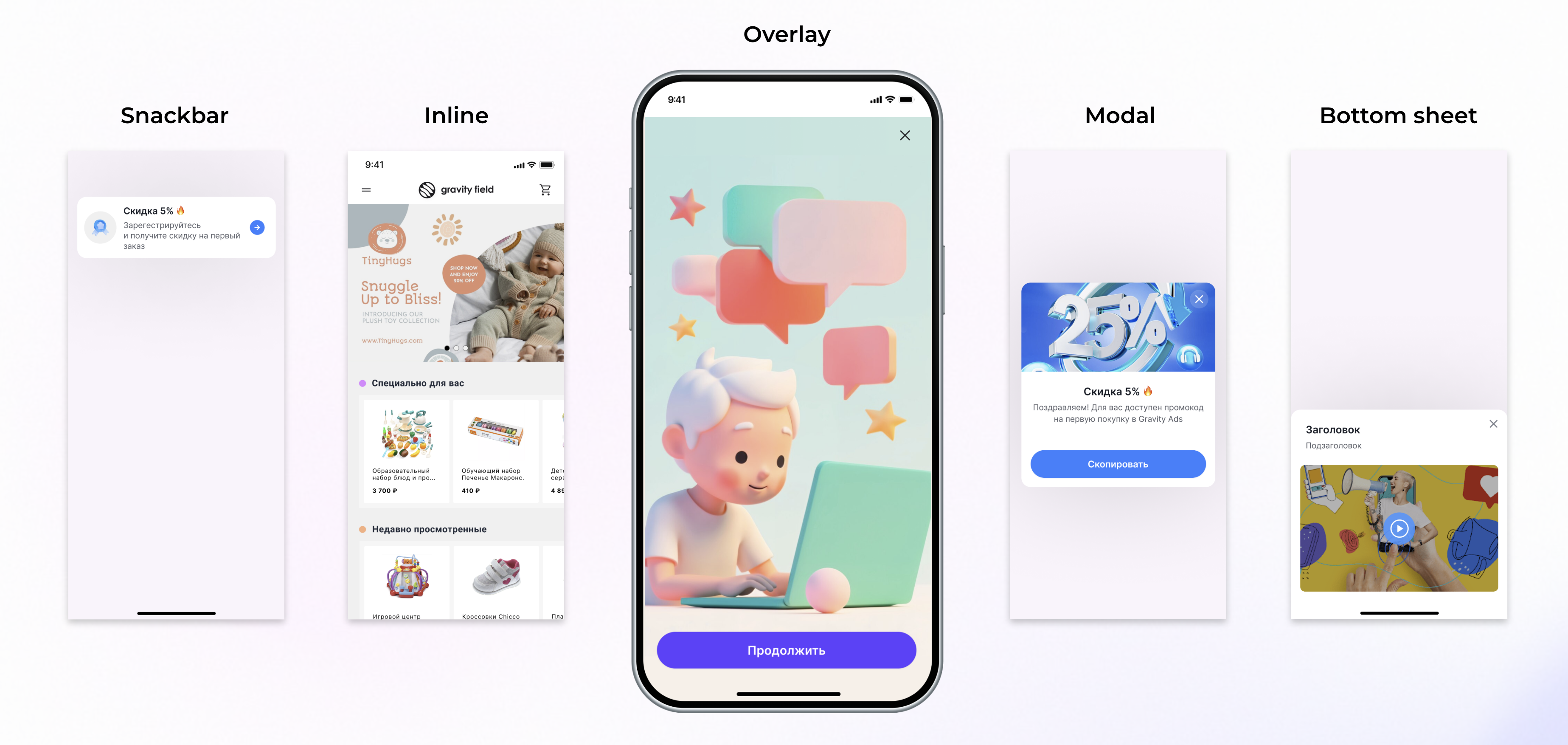
You can use these formats right after the SDK is connected — to launch mechanics, hints, offers and engagement elements.
Support for your own components
If you already have your own components, you can connect them to the platform. The app renders the UI, while the whole configuration — which blocks, in what order and under which conditions — is managed in Gravity Field. It is a full backend-driven approach, without building the infrastructure in-house.
Say your home screen consists of fixed blocks: banners, recommendations, loyalty points, category of the day — with the order hard-coded. With Gravity Field you can manage that layout from the platform interface: reorder blocks, switch individual sections on and off, show different blocks to users from different segments.
A control panel built for business teams

The Gravity Field back office is a Layout Management Platform (LMP). It is a no-code environment adapted to e-commerce scenarios, where teams work independently of engineering. A product manager or a marketer defines exactly what the user sees: which blocks on which screen, in what order, with which display conditions and targeting.
Built-in A/B tests and analytics

Any change can be launched as an A/B test. Gravity Field collects the results automatically and shows how users interact with each variant. You see the data by segment: how conversion, scroll depth, engagement and section entries change. Instead of guessing what will work, you rely on facts — which changes deliver an incremental effect and which do not.
What BDUI changes for an e-commerce team
BDUI is a way to make the product more responsive to what users and the business need. The team becomes more autonomous and reacts to the market many times faster. The outcome shows up in the metrics that matter: conversion, ARPU and retention.
The team reacts faster and tests more hypotheses
When interface changes depend on releases, the team has to ration its hypotheses, picking only the ones that are certain to justify the wait and the engineering effort. With BDUI that barrier disappears: any idea can be validated in hours or days. Product and marketing can afford to experiment far more often, without the fear of burning weeks on a hypothesis that fails.
The app adapts to the user

Users are not all the same, and not all of them should see the same thing. BDUI combined with a personalization engine makes it easy to build personalized scenarios and offers. You can surface premium products to loyal customers, or offer an incentive to those who have not purchased for a while. That helps users feel understood and valued, which lifts engagement and brand loyalty.
You differentiate without extra cost
In a competitive market you have to stand out through experience, not only through price. With BDUI you build a distinctive UX that does not require additional engineering resources. Your app becomes more flexible, and you adapt to market shifts faster than competitors tied to the traditional release cycle.
Want to try it?
Want to know what BDUI can do for your team specifically? Request a demo of the Gravity Field mobile marketing platform, and we will walk you through how it works in practice.