

How do you improve the customer experience and lift conversion and revenue in a digital product through personalization? Here is a practical walkthrough of the approaches and how they play out in real life.
Put yourself in the shoes of Stan, e-commerce director at a fairly large online store selling DIY, furniture and home goods. Home renovation is a long game: a typical project runs for months, the needs along the way are numerous and wildly different — furniture, finishing and building materials, tools — and it generates a stream of repeat purchases. Whoever buys once will come back, provided the experience is good. Every shopper walks a unique path, so the core job is to read their current need accurately, adapt the site to it and help them find the right product. Understanding the request, showing products that match the interest and building genuinely useful recommendations is the foundation for growing the business and lifting conversion.
So how does our hero make the most of the opportunity and grow? Let us walk the personalization path with him, step by step.
Segmentation
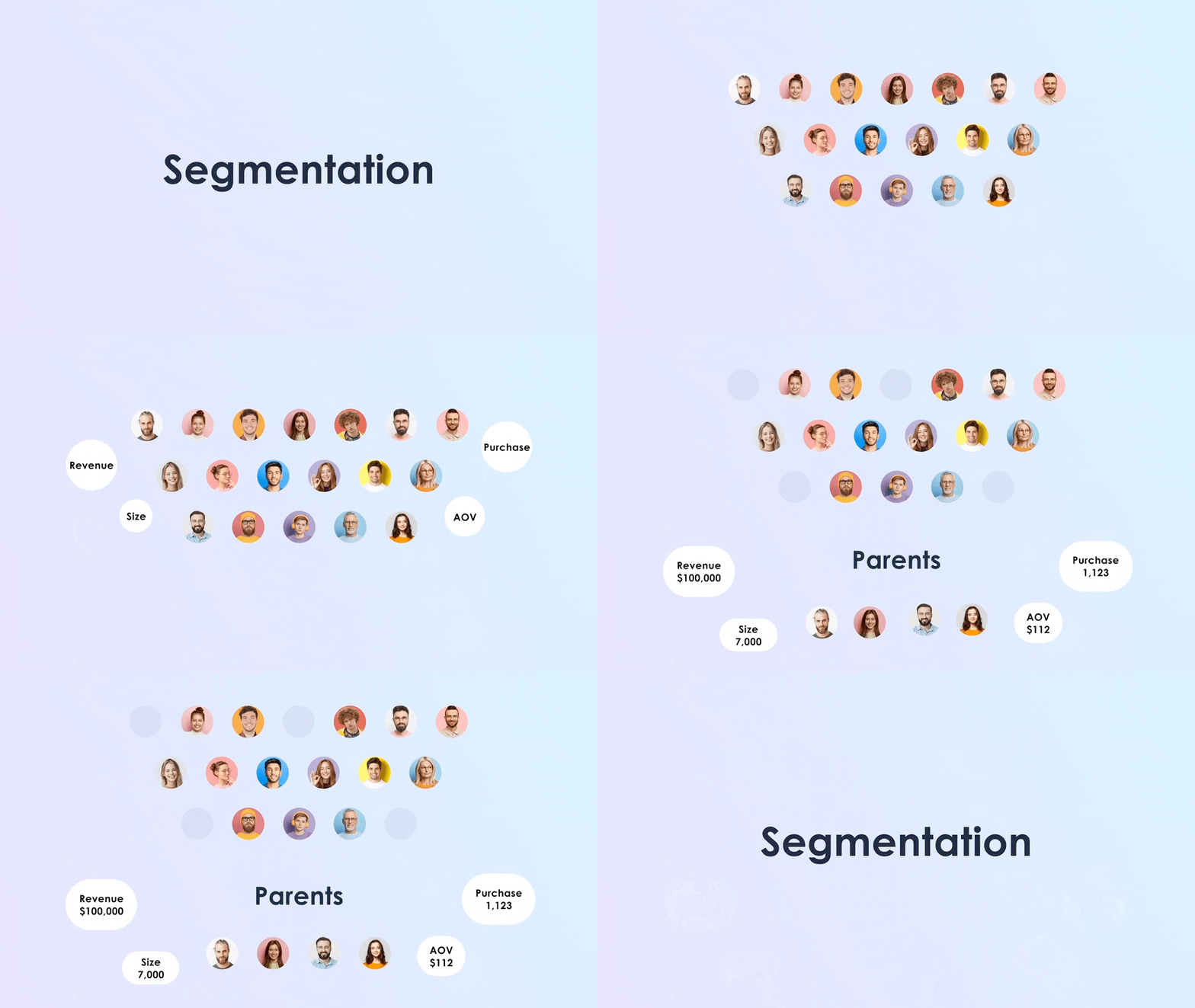
What is Stan’s main job? Right — improve how the store interacts with its users and, through that, lift revenue and conversion. But Stan cannot work with the whole buyer base at once; he needs an individual approach.
Divide and conquer: effective interaction starts with proper segmentation based on the characteristics and needs of incoming shoppers. You work not with the whole flow but with separate audiences that together cover 100% of traffic. Stan needs to pick the few most promising segments and put his effort into moving their numbers.
It matters that the split follows one single principle, so you do not drown in a sea of mismatched segments built on different criteria. There are two main approaches to building audiences: contextual, and preference-based using the affinity profile.
*The affinity profile is a set of personal user preferences, built from how the user behaves on the site or in the mobile app.
In the first case Stan splits segments by funnel stage: separate the shoppers who are still getting to know the assortment from those who have picked a specific item but are still weighing options, and from those who already have products in the cart and are about to hit “Place order”. In the second case Stan focuses on the user’s interest in the moment. The path is built around the category the shopper is looking at right now — and the job is to make that path as simple and comfortable as possible.
Start with 3–4 core segments, then go deeper into finer micro-segmentation once you are hunting for more precise solutions. You have to understand the current needs and interests of every segment, grounded in the latest behavioural data — only then does an effective personalization strategy come together. Dig into the segment: study what it lacks and find the fixes.
Say that after the analysis Stan identifies parents furnishing a nursery as one of the promising segments, and starts looking at its metrics. Segment size, its average order value and its revenue all inform the communication. Stan sees the priority segment has a $100 average order value, and works out that hitting the growth targets requires raising it by 15%. Let us look at the approaches Stan will use to move that metric.
Recommendation strategies

Step one is done — Stan has his segments and is rubbing his hands, thinking about what to offer each of them. There is no shortage of ways to lift conversion, from similar-product recommendations to nudging complementary purchases. Time to build the strategies and choose the algorithms that will produce an offer tailored to each audience. Let us unpack what strategies and algorithms are, how they differ and how they work.
Recommendation blocks are the key point of contact with the user: they introduce the assortment, steer the shopper and surface products that match their interest. Working on recommendations is not only about the content that fills them — it is also about finding the right placement, the right presentation and the right ranking logic. Those blocks are built by specific algorithms and strategies that draw on the context, the funnel stage, user behaviour, interest data and much more.
An algorithm is the narrower concept. It solves one specific task and builds its output from one pattern. Say the shopper is on the site for the first time and sits on the home page: “Popular products” is the natural algorithm there. But once the user is browsing product pages, comparing specific brands of filler, it makes sense to show fillers from other manufacturers via “Similar products”, or putty knives via “Bought together”.
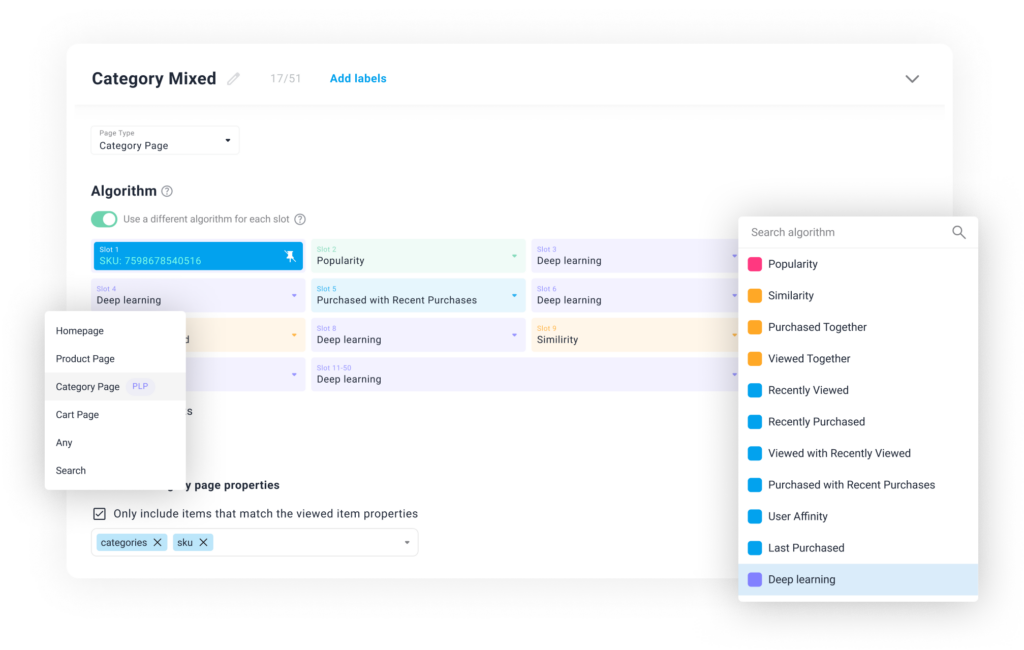
A strategy is the broader concept. It is a set of algorithms equipped with filters (it can show or exclude recently viewed or purchased items, for example), extra settings, and it reacts to user behaviour and context. Say a user is in the cart intending to buy blinds. A smart strategy can first remind them of recently viewed items (maybe they needed one, got distracted and forgot), then serve a selection built by “Bought together” — and will not add a roller-blind bracket to the recommendations. A strategy relies on understanding the audience and the job the visitor is trying to do; it adds perspective, lets you refine the algorithm, return more relevant results and work with users precisely. The balance between business goals and shopper needs matters here: you can tune a strategy so that 80% of the items answer the user’s request while 20% are high-margin products or new brands and models the business wants to push.
You can assemble the strategy and set the ranking rules yourself, based on what specific segments need and on your own read of the situation — in the Gravity Field platform that lives in the “Custom rules” section of the strategy editor. How does it play out? Suppose a batch of products from a new, unfamiliar brand lands in the warehouse: Stan can decide where those products sit in the recommendation output to draw attention to them effectively. He can build the selection by hand with filters (category, price, SKU and so on). Rules also let you correct an algorithm that does not always get it right. An algorithm might mix cheaper, lower-quality options into the similar-products block for premium building materials — but if Stan sets filters on price or manufacturer himself, the output gets sharper.
Many people believe there is a magic algorithm that produces one perfect universal recommendation set for everybody. There is not — the real magic is in the fine tuning of the strategy, which weighs context, user behaviour, the page the customer is on, their interests, the merchandising preferences of the business and a whole range of other conditions. An even more powerful lever is running strategies per segment: in the very same recommendation block you can show one kind of content to iPhone users in London and another to desktop visitors in Manchester.
A/B testing
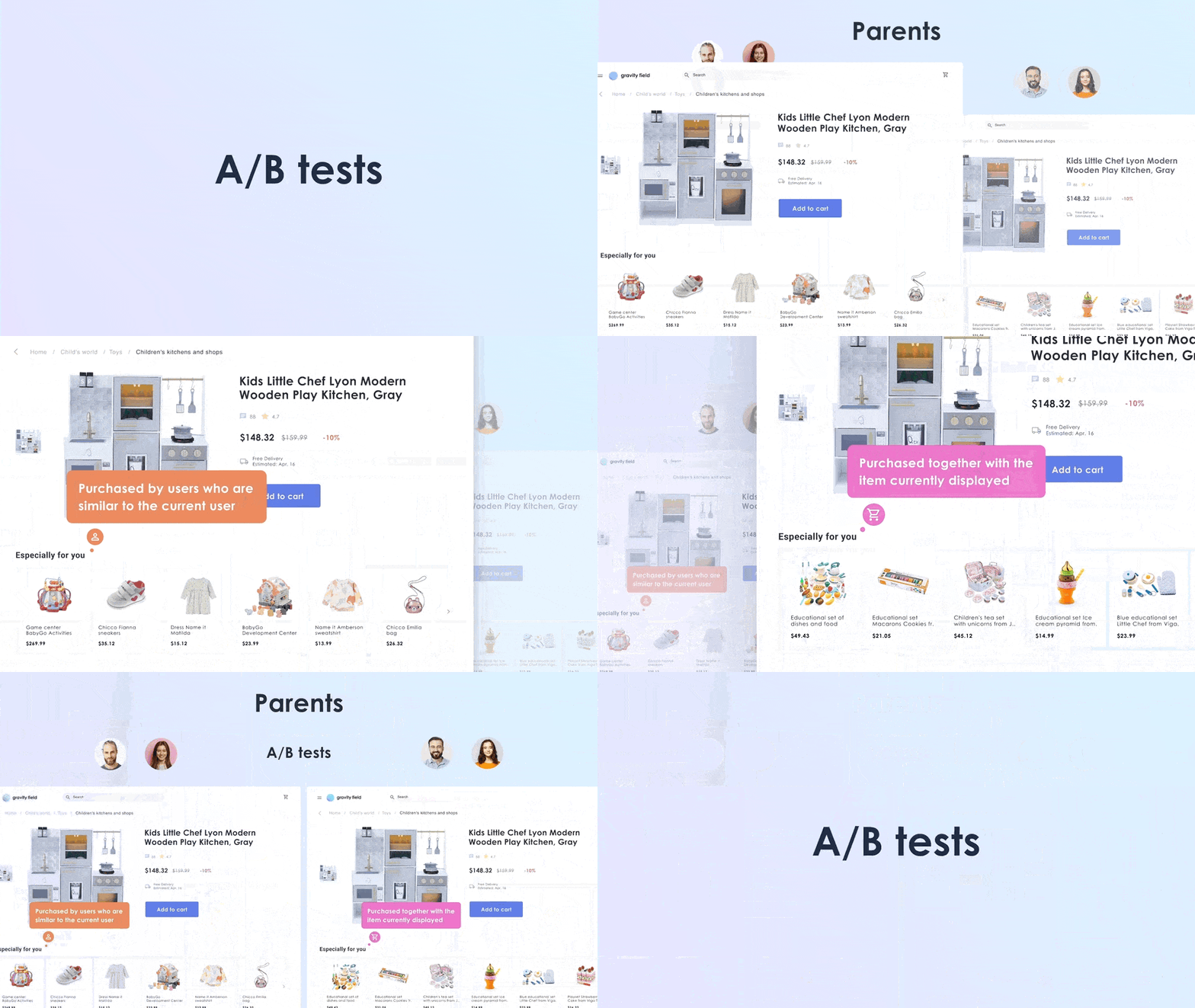
The strategies are built and the algorithms are picked, and now Stan faces an important choice — which of them will perform best for each segment, improve the experience and lift conversion? Time for an A/B test.
The algorithm controls the output — which products appear and in what order — and tests tell us which algorithm or strategy works better. Put two strategies into a test, wait, then read the metrics and pick the winner. You can test not only the strategy itself but the placement of the recommendation block: where exactly on the site it improves the interaction.
Say Stan decides to compare two strategies on the cart page: the first offers products via “Bought together”, the second serves personalized products picked from the user’s affinity profile that have nothing to do with what is already in the cart. Alongside those two he can add a “control group” — the baseline where the recommendation block is not shown at all. A typical A/B test runs for two weeks (behaviour differs a lot between weekdays and weekends, so two weeks is the sweet spot for collecting data). Reading the results tells Stan which solution won.
We validate every hypothesis with an A/B test. Combining A/B tests with personalization lets us not only confirm the hypothesis but also improve the user experience substantially, by serving the most relevant content.
It matters to test not only what you show but how you show it — the naming, the button styling, the backgrounds. The personalization platform you use should let you experiment with design without pulling in developers: pick an element on the site and change its size, position, colour and more by hand.
A/B testing suits stable, long-lived decisions: Stan wants to choose the product-card design, so he puts several variants into a test. But what if you need a fast answer for dynamic content — home-page banners that change weekly with the promo calendar? That is where dynamic allocation comes in: an algorithm that decides on its own how much traffic each banner variant gets. It analyses metrics continuously and keeps self-optimising for profit.
*Dynamic allocation is the Gravity Field engine built on machine-learning algorithms (known as “Multi-Armed Bandit” and “Contextual Bandit”) that automatically serves the most relevant offer to each user at each moment. At the moment of interaction the engine picks the optimal offer or interface variant for that user and shifts traffic towards the best-performing variation.
Analytics

Tests are live, the team is holding its breath — we are close to the finish. Time to read the metrics.
Stan put a couple of strategies into a test, skimmed the metrics two weeks later, picked the stronger one and moved on to other work with a sense of a job done. The Gravity Field team talks him out of stopping there: having chosen the better of the two, keep testing it against the other strategies on the shortlist.
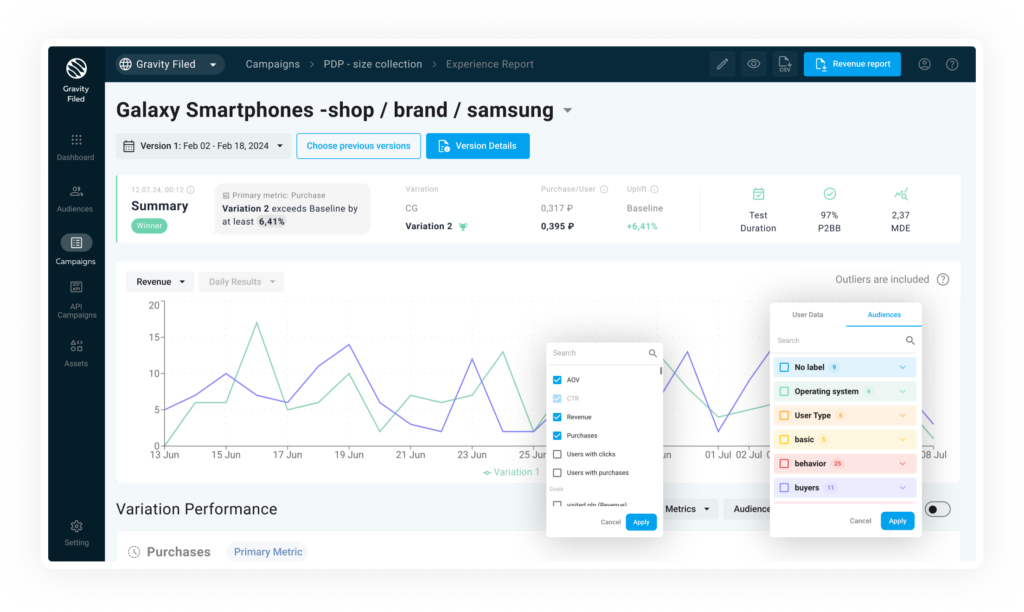
It also pays to look closely at the metrics and not settle for the variant that suits the “average” shopper — break it down by segment. The strategy that looks best overall may simply suit mobile users, who outnumber desktop visitors. On desktop the numbers can look different, and another variant may win there. Once the results are read audience by audience, you can keep experimenting with strategy selection at the level of individual micro-segments.
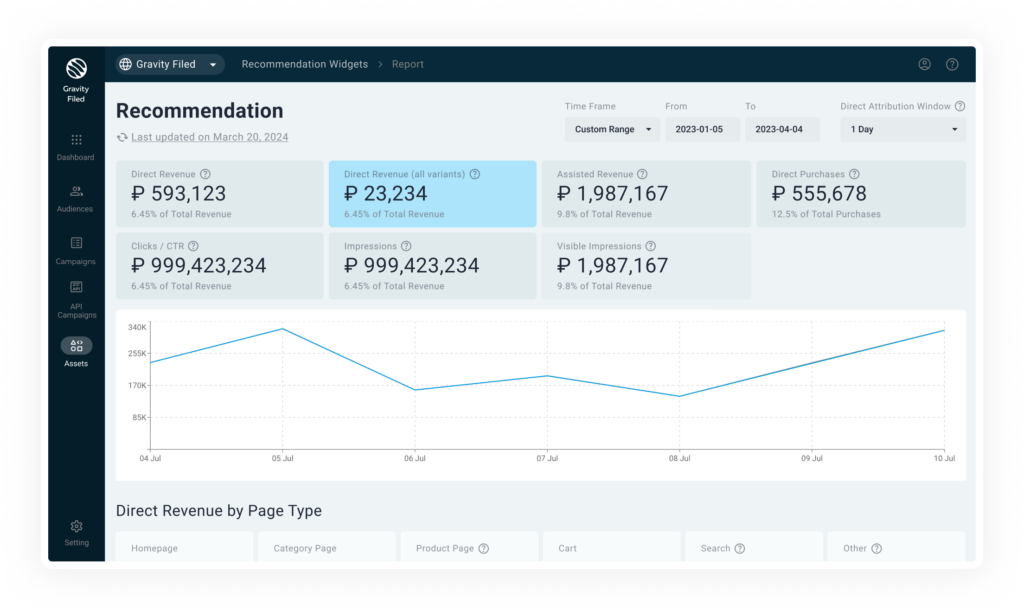
On top of that, Gravity Field reports analytics not only for tests but for recommendation strategies. Tests tell you the metrics of user groups, but they say little about how the strategy itself performed — how clickable and how sales-driving it was. The strategy report shows clicks on recommendation widgets, direct and assisted revenue, impressions and unique views of the widget (only genuine views count: at least 50% of the widget on screen for at least one second) and much more.
Three pillars of the Gravity Field platform
Segmentation, building strategies, testing and analysing the data are the standard stages of effective, purposeful personalization. Optimising each of them continuously produces obvious results: a better experience and more revenue. That is exactly how our clients work in Gravity Field. And we have something to add to the standard set.
Beyond the base functionality of a personalization platform we offer solutions you will not find elsewhere. First — launching and testing hypotheses in a continuous pipeline without involving the engineering team. The user picks, configures and tests ideas in record time and at any volume. Removing the hand-off to developers saves the lion’s share of budget and time. Second — flexibility in tuning recommendations. Unlike the usual black-box approach, where the algorithm decides the ranking logic for you and returns results that are not always relevant, Gravity Field lets you work the strategy out in detail: custom rules, combinations, the right filters. And third — granular, data-driven personalization. We do not simply pick the best strategy; we read test results audience by audience and find the right approach for each segment.
Stan’s work with Gravity Field ended well: attentive parents found the perfect acrylic paint for the nursery and picked up comfortable rollers and a paint tray along the way, while Stan got a tangible lift in profit and learned a lot about his users. The A/B tests he ran identified behaviour patterns across buyer segments and produced valuable data about their interests and preferences — data he can use to build sharper communication. And of course we are not stopping here.
Join us.


