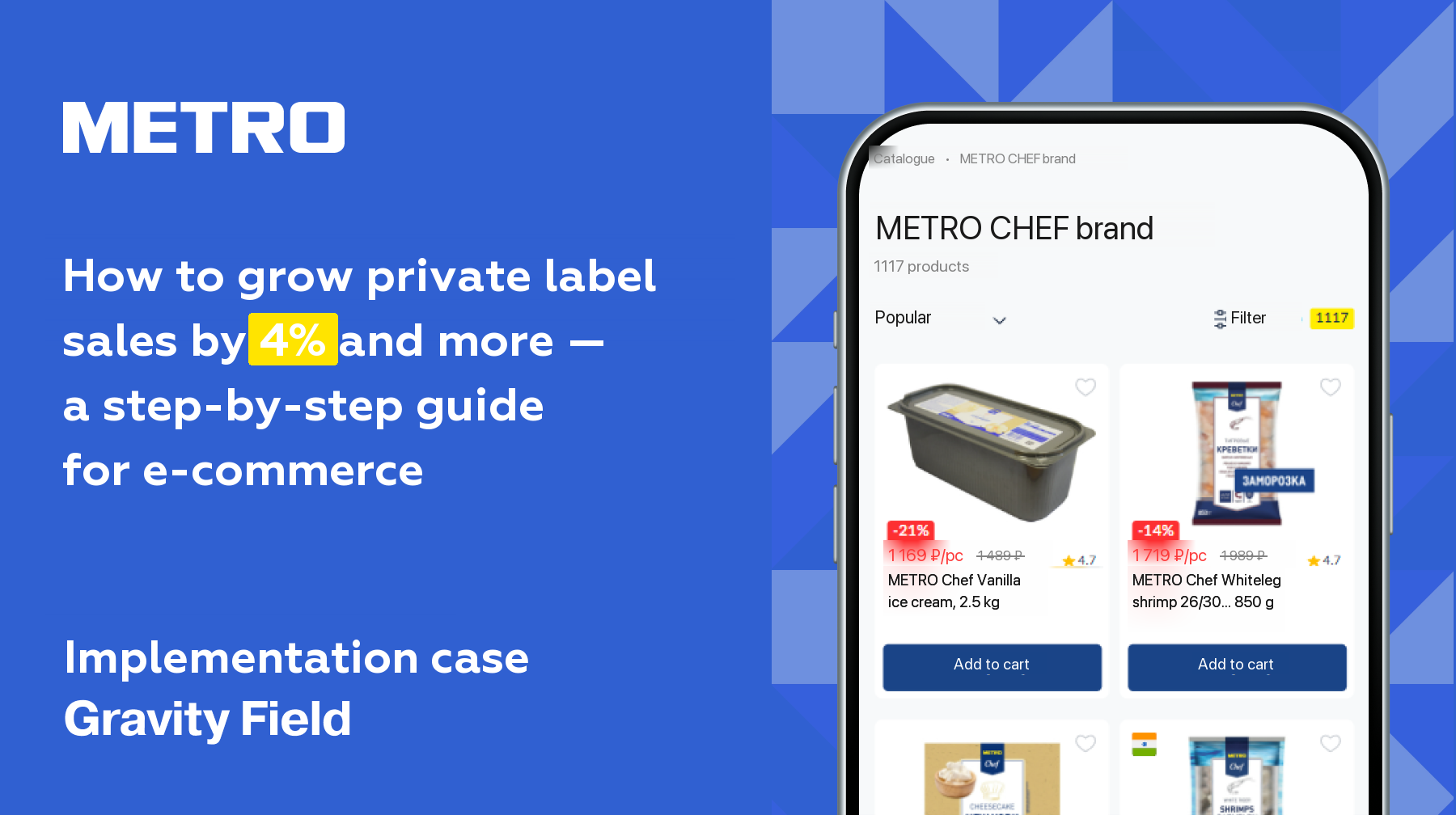
E-commerce is entering the era of margin. When acquiring a new customer costs a small fortune, profitability comes down to growing private labels. 2025 showed that private-label success no longer rests on a single factor — price, packaging or shelf space. Today a brand’s marketing strategy is inseparable from how that brand is presented in digital channels.
This case study looks at the practice of METRO, one of the largest international wholesale operators, which used the Gravity Field personalization platform to grow private-label sales and small-wholesale metrics on its website by an average of 4% in just two quarters of 2025. You will see how smart recommendations turn first-time visitors into loyal buyers of METRO Chef, ARO and Fine Life — and how to carry a valuable offline format into online without giving up margin.
Introduction: why private label is a growth point for your online business
Private labels are not just products. They are a brand-management instrument inside your online catalogue and a key to the healthy economics of a retail chain. Private labels let you offer unique items, control pricing and — most importantly — build net profit you do not have to share with partner brands. The advantages of owning a brand online become obvious the moment you stop competing on price with the giants and start building loyalty to your own ecosystem.

“Promoting a private label online has its own specifics. In a physical store the shopper sees the whole range and can pick the product up. On a website it is just one card among thousands. The job of online teams today is to tune the interface so that it nudges the customer towards high-margin items on its own, taking purchase preferences and behavioural signals into account.
METRO set an ambitious goal: grow private-label sales, raise awareness of its brands (METRO Chef, RIOBA, Sigma, ARO, Fine Life) and strengthen its market position.”
Andrey Andreev, Head of E-commerce Merchandising at METRO
The key growth driver was not a discount but smart personalization on the Gravity Field platform, which makes it possible to promote your own brand inside your own online store effectively.
Why METRO bets on private label: three strategic goals
Before we get to tactics, the context matters. Private-label growth at METRO served three overarching goals that map directly onto brand management in online retail:
- Higher gross profit: own brands carry a better margin than third-party ones.
- Stronger loyalty: a shopper who trusts a retailer’s private label is tied to the ecosystem far more tightly than one who is hunting for a specific brand. Loyalty analytics matter here, so you can see how often a customer comes back for your label.
- A stronger image: brands such as METRO Chef (premium) and Rioba position the company as an expert in its field.
So how do you translate those ambitions into digital and get a measurable result? Here are three strategies delivered with Gravity Field.
Strategy 1: introducing private label through cross-sell to new users
The problem: a new user lands on the METRO site, perhaps having heard about the quality, but does not know the range. They search for specific products and never notice the private-label offer. How do you show them that METRO Chef is a worthy alternative to expensive Italian brands?
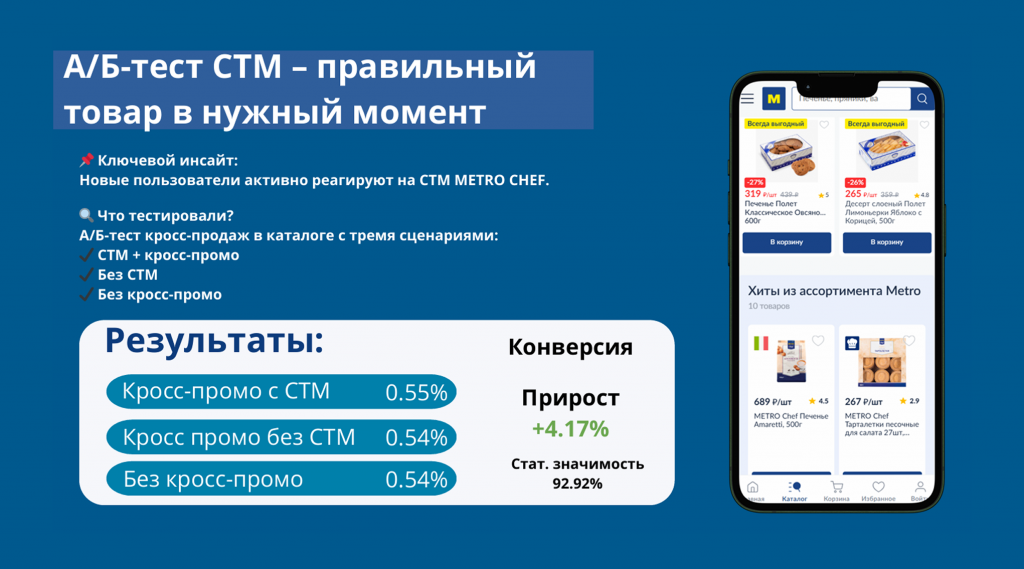
The Gravity Field solution (A/B test, Q4 2024 – Q1 2025):
The team shipped a simple but elegant change: the recommendation widget on catalogue pages started cross-selling products from other sections — but only private-label items. This A/B test ran exclusively on the new-user segment. It is classic cross-marketing, except the partner is your own assortment.
What this gives a product manager:
Instead of simply recommending “similar” items (which often means the same third-party brands), the algorithm introduces a newcomer to the retailer’s ecosystem. You are effectively saying: “Since you came to us, try the best of what we make ourselves.” It is an effective way to sell private label online without aggressive pressure.
Business results:
- Revenue growth in the test group: +3.02%.
- Growth in the number of purchases: +4.17%.
- The headline metric: direct revenue per thousand impressions in the private-label group was 2x higher (85 ₽ against 37 ₽ in control).
- Purchase conversion from the recommendation widget grew 3x (0.99% against 0.31%). That kind of private-label growth was possible because the offer landed precisely in context.
Takeaway for online retail teams:
New users are a warm audience for your private labels. They came for the store’s brand, which means they are predisposed to trust its expertise. Do not waste that moment on somebody else’s brands. Study how private-label promotion works at different stages of the customer lifecycle and grow repeat private-label sales.
Read next: how recommendation strategies drive repeat purchases in online stores
Strategy 2: bringing the offline experience online through small-wholesale pricing
The problem: one of METRO’s key advantages is the small-wholesale format. In its stores, shoppers are used to seeing the saving when they buy a batch. Online that mechanic is usually lost — the user only sees the unit price and misses the value of the multipack. What is needed is a smarter way of presenting the value proposition, much like the assortment optimization work described in our other METRO case.
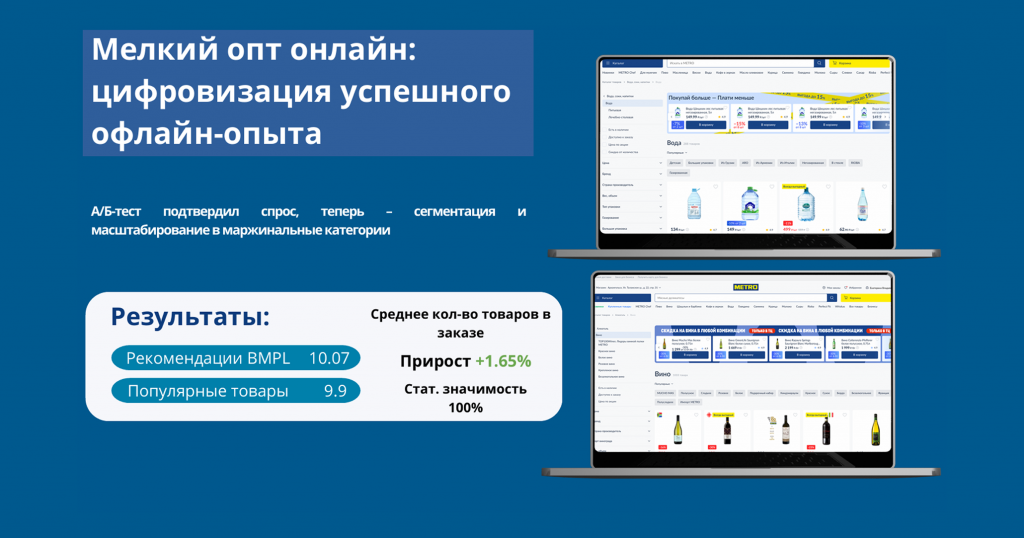
The Gravity Field solution (A/B test, Q4 2024):
During the test the site started showing users two prices at once: the price per unit and the reduced price for a small-wholesale batch (a multipack, for example). This is not simply a discount — it is a visualisation of the saving that every visitor to a METRO store already recognises.
What this gives a product manager:
You transfer the physical sense of a bargain into digital. The shopper sees that taking more saves money. For private labels, where the margin is higher, this is an ideal way to raise the average order value without giving up profit. It is one of the most reliable levers for private-label conversion.
Business results:
- Revenue growth: +3.46%.
- Growth in the number of purchases: +3.85%.
- Average order value growth: +1.3%.
Takeaway for e-commerce teams:
Do not hide your formats. If you have a strong offline USP, put it straight into the interface. Shoppers come to METRO for wholesale — show them wholesale immediately and they will buy more. That kind of product card and listing optimization improves behavioural metrics across the board.
Strategy 3: micro-interactions with a big effect — a private-label storefront in the empty cart
The problem: an empty cart is where you lose the customer. Usually it holds a sad banner or a “start shopping” prompt. METRO decided to put that space to work.
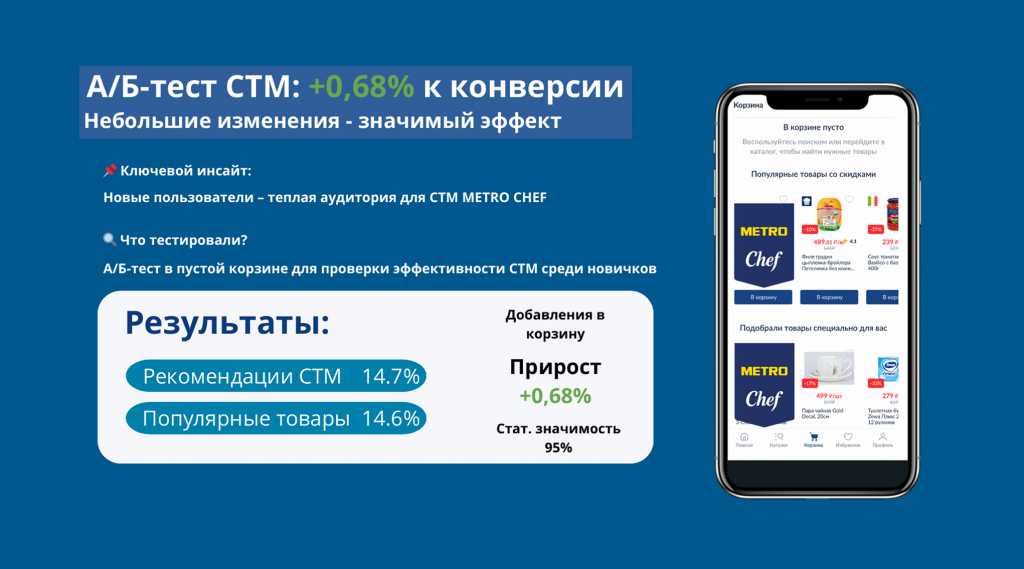
The Gravity Field solution (A/B test):
Instead of the standard popular-products recommendation, 50% of new users saw a private-label selection in the empty cart. The other 50% saw the usual bestsellers.
What this gives a product manager:
A way to use even the “dead” zones of a site to teach the user something, unobtrusively. This is the moment when a customer has already signalled intent (they opened the cart) but has not chosen products yet. It is a good example of brand management in online stores through micro-interactions.
Business results:
- Add-to-cart rate in the private-label group: 14.7% (against 14.6% in the bestsellers group).
- Statistically significant conversion uplift among new users: +0.68%.
Takeaway for digital commerce teams:
A 0.68% uplift may sound small, but for a large retailer that is thousands of extra orders a month. Even minor changes in display logic produce a meaningful effect at scale. The point is to lean on data rather than intuition.
Step-by-step guide: how to repeat METRO’s success in your own company
Based on METRO’s experience and the capabilities of Gravity Field, we put together a four-step roadmap that will help you grow the private-label share of the basket organically. Treat it as a practical guide to private-label strategy in a digital environment.
Step 1. Segment your audience by how “warm” they are towards your brand
There is no need to show the same thing to everybody.
- Advice: carve out the cohort of new users (the first 1–3 visits, or the first 30 days, for example).
- Why: they are your clay — you can shape them into loyal buyers. As the METRO case shows, newcomers are the most responsive to private-label offers. Automation matters here, so the system decides on its own who sees what.
Read the step-by-step guide to identifying key user segments on an online store automatically with the Gravity Field Segmentation module
Step 2. Put smart widgets in the “cold” zones of the catalogue
Do not limit private-label recommendations to private-label pages.
- Advice: use cross-sell mechanics for private-label brands too. If someone is looking at meat, offer a sauce. If they are looking at grains, show cooking oil. That strengthens the competitiveness of your private labels by presenting them as a ready-made solution.
- How Gravity Field helps: the platform can swap the contents of recommendation widgets, filling them not with generic “similar” products but specifically with private-label items that fit the context.
Step 3. Communicate the value of the format (“buy more, pay less”)
Analyse your assortment. Which private-label products are more profitable to sell in multipacks?
- Advice: do not make the user click into the product card to find the pack price. Show the comparison (unit price / wholesale price) right in the listing or in the widgets.
- How Gravity Field helps: being able to A/B test such mechanics, and to configure price display per user segment, lets you confirm or kill a hypothesis quickly — exactly as METRO did.
Step 4. Use every touchpoint
Audit your site and app for “dead” zones: the empty cart, the order confirmation page, the 404 page.
Read next: best practice for placing recommendation widgets on an online store — where to put them and which products to show
- Advice: wherever the user’s eye is looking for what to do next, place relevant private-label products. An empty cart is the perfect place for a gentle nudge: “Start with our own best products.” And if you operate across regions, remember that private-label consumption differs by region — adapt the selections.
- How Gravity Field helps: even a pinpoint change such as swapping the content of an empty cart takes minutes to configure on the platform and needs no developer involvement.
Summary for the product manager: why it worked
The success of the METRO cases rests on three pillars available in the Gravity Field platform:
- Flexible segmentation: the ability to work precisely on new users without disturbing an established audience that already has its consumption patterns.
- Context: recommendations sit inside the user experience (catalogue, cart) organically, without looking like intrusive advertising.
- Measurability: every decision was validated with an A/B test, which gave a transparent picture of the impact on revenue and conversion.
Together these form a modern approach to promoting your own brand inside your online store with maximum efficiency and no wasted budget.
Conclusion
Growing private-label sales is not a one-off campaign but systematic work on the customer experience. As METRO’s experience shows, changes to recommendation logic that look minor at first glance can deliver a 4% revenue uplift and a 300% increase in private-label conversion among new customers. It proves that your site can sell smarter using the traffic you already have.
Now that margin is becoming the primary KPI, the ability to steer demand towards your own brands rather than somebody else’s turns into a competitive advantage. Investing in private-label online sales today is the foundation of tomorrow’s profit.
🎯 Your next growth point — a pilot launch of hypotheses
Do not put margin growth off until tomorrow. Start small — test one of the hypotheses described above. Launch a two-week A/B test of private-label recommendations for the new-user segment in your catalogue, for example.
Request a Gravity Field demo today to see how flexible personalization settings can be rolled out on your project without loading your IT team. Just go to the Gravity Field website and click “Request a demo”. Let your private labels work for you 24/7.

