How Europe’s largest consumer electronics and appliance retailer rolled out personalization for its European customers and increased average revenue per user by 14%.

About the company
MediaMarkt is Europe’s largest consumer electronics and appliance retailer, with a turnover of 22 billion euros (2.4 billion of it e-commerce). With sales growing steadily, the company set itself the task of unifying online and offline data to understand and manage the customer experience better. MediaMarkt chose the Dynamic Yield platform as its core solution.
We used to have a large number of tools for different purposes: testing and analytics, recommendations, customer communications and so on. Most of them could not be integrated with each other, which made the work very difficult. In 2017 we started working with Dynamic Yield — and cut our effort significantly. On top of that we gained a broad new set of capabilities that let us launch and test different scenarios weekly, with a focus on building the right customer experience.
The main objectives
MediaMarkt, one of Europe’s biggest retailers, has come through digitalisation successfully and now leads both offline and online across the continent. Scaling the business further raised an entirely new set of tasks the company planned to solve with its partner Dynamic Yield:
- design and roll out a personalization programme
- create the conditions for continuously generating and testing personalization ideas and scenarios
- unify transactional data from offline and online
- consolidate an excessive number of systems that were not integrated with one another
- minimise dependence on IT and development for marketing and content tasks
- use real-time demand data to promote the most popular product offers.
How the project was delivered
To address these objectives, MediaMarkt defined several main workstreams:
1. Centralising data sources
A custom integration from Dynamic Yield let MediaMarkt collect, synchronise and analyse all its customer data in one place. That made it possible to run targeted personalization both on the website and in the mobile app.
The data set included:
- real-time information about user behaviour on the site and in the app, including device type, traffic source and more
- modelled data from MediaMarkt’s in-house data science team, based on a wide range of user attributes (CLV, churn probability and so on).
2. Recruiting new loyalty programme members
Collecting email addresses is the first step towards a base of loyal customers and more repeat sales. For this, MediaMarkt launched a personalized email capture pop-up for different segments, where each audience saw its own variant depending on gender, location and other attributes.

Banner variants for different segments: men and women. Buttons read “Sign up!” or “I want my 10 euros”.
3. A “Social Proof” message on the product page
Social Proof is the name of a personalization scenario in which the site displays, in various formats, that X people have bought or viewed this product over period N, and similar messages.
How do you sell a popular product even faster? An element was added to the product page showing how many people had bought it in the last 48 hours. The campaign played on a sense of urgency, which ultimately increased order conversion and add-to-cart volume.
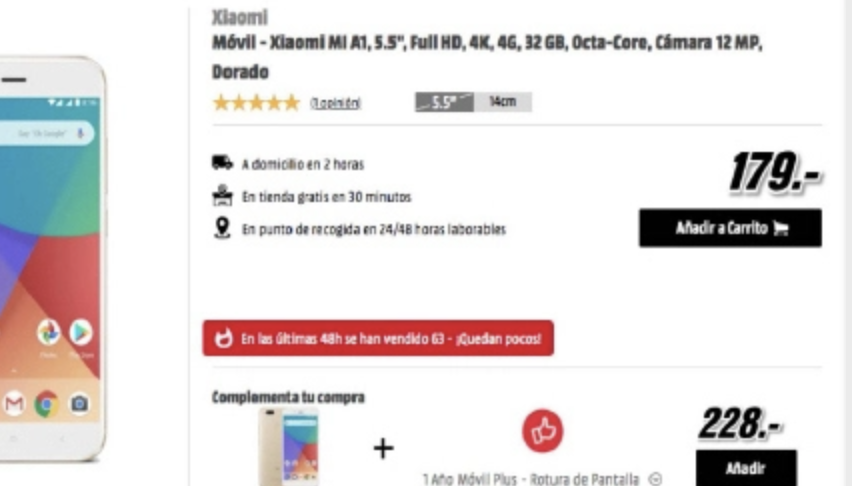
A product page notice saying stock is low and that 63 units were sold in the last 48 hours
4. Product recommendations at the main stages of the customer journey
Using the Dynamic Yield recommendation engine, MediaMarkt launched a variety of product recommendation mechanics on the home page, the category page and the product page. Home page visitors saw several recommendation widgets with the most relevant products from different product categories — different for each user.

The recommendation widget is built automatically from strategies such as “Recommended for you”, “Recommended in this category” and others
5. Targeted recommendation strategies for different user segments
On top of all that, the platform’s algorithms tested different combinations and interactions of recommendation strategies, using machine learning to monitor and determine the best result for each individual user.
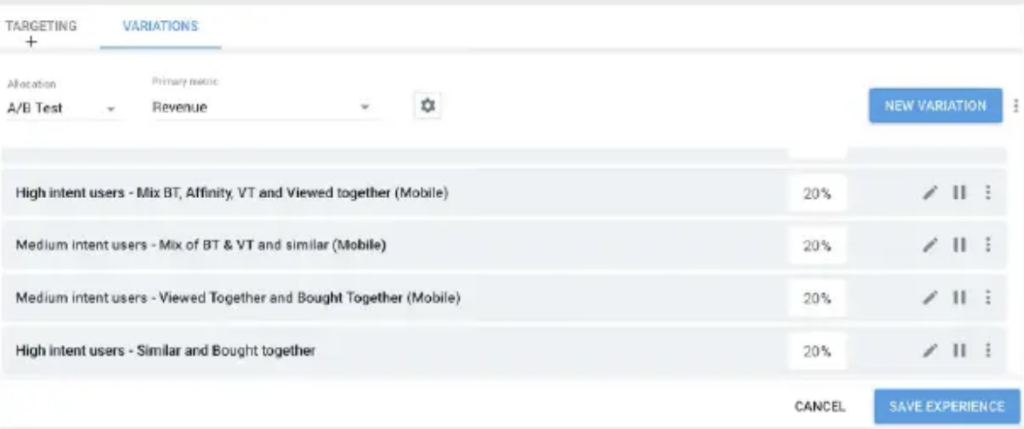
Configuring different recommendation strategies in the platform: “Bought together”, “Viewed together” and “Similar products”
Results
To measure the outcome, MediaMarkt — a data-driven company — set up a global control group in which 5% of all online traffic was excluded from every Dynamic Yield campaign. That gave confidence that the real business impact and the ROI of the personalization campaigns were being measured correctly.
In the age of digitalisation, large companies need solutions that can combine what they already have with more innovative technology. Thanks to Dynamic Yield’s technology for consolidating data, building a personalized customer experience and measuring customer activity across a broad set of metrics, MediaMarkt was able to meet the challenge and double its profit.
14%
increase in average revenue per user
54%
growth in add-to-cart volume
31%
growth in purchase conversion from the Social Proof campaign on product pages


